
How to Choose Danish Modern Furniture for Your Home
Updated: 16 hours ago
Table Of Contents

Danish Modern furniture has a way of making a room feel considered without making it feel formal. A chair might have an elegant curved back, yet its purpose is simple: to support someone comfortably. A sideboard might look understated, but behind its doors is storage designed for everyday life.
That balance between beauty and usefulness is a major reason Danish Modern design continues to appeal to homeowners.
But choosing the right pieces takes more than recognizing a distinctive silhouette. A chair needs to fit the people using it. A dining table needs to accommodate meals and conversation. A credenza needs to hold what you actually own.
At VNTG, we appreciate furniture that earns its place in a home. If you're exploring Danish Modern design for a Honolulu apartment, a family home, or a dedicated workspace, here are the considerations that matter most.
What Makes Danish Modern Furniture Different?
Danish Modern emerged as an influential design movement during the twentieth century, especially in the decades following World War II. Its designers explored how furniture could combine skilled craftsmanship, natural materials, clean forms, and practical function.
The movement is associated with designers such as Hans J. Wegner, Arne Jacobsen, and Finn Juhl, whose work helped establish Danish furniture's international reputation.
For a deeper look at Denmark's design heritage, the Designmuseum Danmark is a useful educational resource.
Although Danish Modern furniture is often grouped under the broader mid-century modern label, it has a recognizable emphasis on human proportions and material expression.
Common characteristics include:
Carefully shaped wooden frames and exposed joinery
Curved chair backs and armrests designed around the body
Tapered legs and visually light furniture profiles
Practical storage integrated into restrained forms
Materials selected for both appearance and everyday use
Not every Danish Modern piece has every characteristic. More importantly, not every vintage wooden chair or cabinet is Danish Modern.
For your home, the most useful question is not whether a piece checks every stylistic box. It's whether its design makes sense for the space and the way you live.
Start With Function Before Choosing a Statement Piece
It's tempting to begin with the most eye-catching furniture in a collection. But Danish Modern design is particularly rewarding when you start with what a piece needs to do.
Consider a lounge chair. It might look beautiful from across the room, but does its seat height make getting up comfortable? Are its armrests positioned naturally? Is it intended for upright conversation or extended relaxation?
The same principle applies to larger furniture.
A dining table should suit the number of people who use it regularly. A desk should provide enough working space. A storage cabinet should accommodate the belongings you intend to put inside.
Use this quick comparison when deciding which category deserves priority.
Furniture type | What to evaluate first | What Danish Modern design can contribute |
Lounge or dining chair | Seat height, comfort, support | Considered proportions and expressive wooden forms |
Sofa | Seating depth, upholstery, room size | Clean lines and a less visually bulky profile |
Coffee table | Height, reach, surface area | An understated centerpiece with practical use |
Dining table | Seating capacity, clearance | A functional gathering surface |
Credenza | Interior storage, access | Concealed storage with a refined silhouette |
Desk | Work surface, legroom, equipment | A workspace that feels like part of the home |
A piece can be beautifully designed and still be wrong for your needs. Choosing function first helps avoid that mismatch.
Choose Chairs for the Way You'll Actually Sit
Chairs are among the most recognizable expressions of Danish Modern design. Many feature sculptural backs, gently curved frames, and an attention to how the body meets the furniture.
However, two chairs with similar visual appeal may feel completely different.
When evaluating a dining chair, check whether the seat height works with your table. Sit with your feet comfortably positioned and consider how the back supports you during a full meal.
For lounge seating, pay attention to the angle of the backrest, seat depth, and armrest height.
Explore our chairs and accent seating collection when comparing different forms and seating experiences.
If you're furnishing a larger living area, consider how a Danish Modern chair might work alongside one of our couches and mid-century modern sofas.
The furniture doesn't need to come from the same designer or period. Compatible proportions and comfortable seating relationships matter more than a perfectly matched set.
Pay Attention to Proportion, Not Just Dimensions
Danish Modern furniture often appears visually lighter than its dimensions suggest.
Slender legs, open spaces beneath cabinets, and gently shaped frames can make substantial furniture feel less imposing.
That quality can be especially useful in homes where living and dining areas share one open space.
Still, visual lightness isn't a substitute for measuring.
A coffee table might have an elegant low profile but still extend too far into a walkway. A sideboard might appear streamlined yet require considerable wall space.
When considering vintage coffee tables and low-profile surfaces, compare their height with your sofa and check the clearance around the seating area.
For dining spaces, our dining tables and gathering surfaces provide a starting point for comparing shapes and proportions.
Remember to account for chairs when they're pulled out, not just when they're tucked beneath the table.
The goal is to create a room where furniture feels appropriately scaled and movement remains comfortable.
Let Storage Furniture Do More Than Hide Clutter
One of the most practical applications of Danish Modern design is storage.
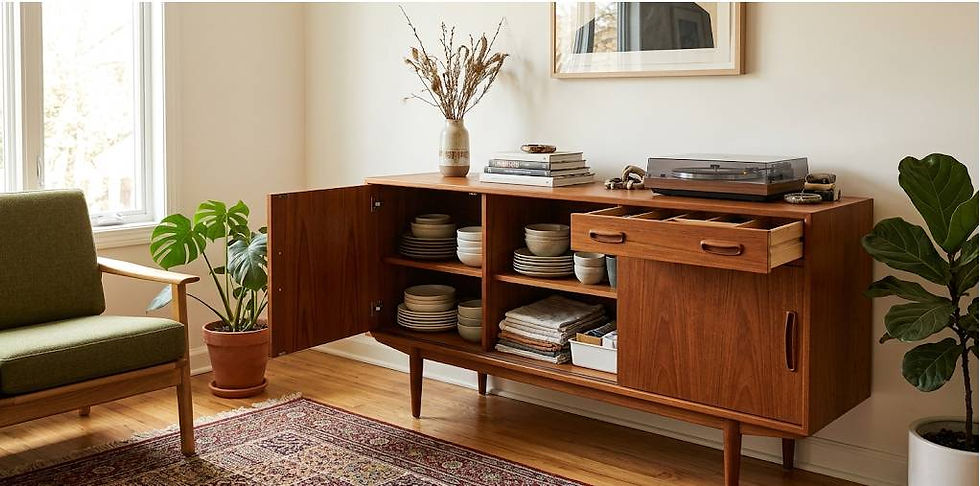
Credenzas and sideboards can provide substantial cabinet space without looking like purely utilitarian furniture. Sliding doors, drawers, and long horizontal forms can make storage feel integrated into the room.
Before choosing a piece, identify what you need to store.
Dining linens and serving dishes may call for a different interior arrangement than books, electronics, or office supplies.
Our credenzas and mid-century modern sideboards offer examples of how storage can become a defining feature of a room.
Consider door operation as well. Sliding doors can be helpful where space is limited, while hinged doors need room to swing open.
A sideboard should make your belongings easier to access, not simply give them a more attractive place to disappear.
Bring Danish Modern Thinking Into the Home Office
A workspace benefits from the same design priorities: useful proportions, comfortable movement, and surfaces that serve a clear purpose.
A vintage wooden desk can bring warmth to a home office, particularly when the room also functions as a bedroom or living area.
But a beautiful desk isn't automatically suitable for modern equipment.
Check the available surface area, legroom, and whether your monitor, keyboard, and other essentials can be positioned comfortably.
Browse our desks and workspace surfaces to compare different desk forms. You can also explore our broader home office furniture collection when considering a coordinated workspace.
A vintage desk can be an appealing choice for writing, reading, or laptop-based work. More equipment-intensive setups may require additional ergonomic considerations.
Rather than forcing a desk to perform a task it wasn't designed for, evaluate how it fits your actual workday.
Complete the Space Without Losing the Design's Simplicity
Danish Modern interiors are often associated with restraint, but that doesn't mean rooms must feel empty.
Lighting, artwork, and textiles can introduce contrast while allowing furniture's materials and shapes to remain visible.
A sculptural lamp can complement a wooden sideboard. A textured rug can soften the appearance of a room filled with hard surfaces.
Explore our lamps and decorative lighting for ways to introduce useful illumination and visual interest.
Our decor, rugs, and art collection can help connect furniture with the rest of your interior.
For additional context on how furniture and decorative objects fit within the wider history of design, explore the Cooper Hewitt, Smithsonian Design Museum.
A useful approach is to let one or two pieces lead visually, then choose supporting elements that share a material, color, or shape.
What Should You Prioritize When Choosing Your First Piece?
You don't need to furnish an entire home at once to appreciate Danish Modern design.
Starting with one well-chosen piece gives you time to understand how its proportions, materials, and function interact with your existing furniture.
Your priority | A sensible starting point | Why it may work |
Add a design focal point | Accent chair | Introduces a distinctive form without replacing a room's main furniture |
Improve everyday gatherings | Dining table | Makes function central to the choice |
Reduce visible clutter | Credenza | Combines storage and visual character |
Refresh a seating area | Coffee table | Changes the room's center without replacing the sofa |
Create a dedicated workspace | Desk | Gives a practical activity a defined place |
Before committing, review the piece's condition, dimensions, and intended use. For older furniture, ask questions about repairs or modifications where relevant.
These checks support a better purchasing decision without requiring you to become a furniture historian.
Discover Danish Modern-Inspired Design at VNTG
At VNTG, we specialize in vintage, mid-century modern, and contemporary design. Our inventory includes furniture from different periods and origins, so not every piece is Danish Modern.
That variety can be useful when you're looking for furniture that reflects Danish Modern principles without insisting that every item share the same provenance.
Visit our showroom in Kakaʻako, Honolulu, to compare pieces in person. Seeing their proportions and experiencing their comfort can reveal details that photographs alone don't communicate.
You can also enjoy Café VNTG, our in-store coffee experience while exploring the showroom.
Our inventory changes, and the online collection represents only part of what's available to see in person.
Shop the Collection
Whether you're drawn to the practicality, sculptural forms, or understated character of Danish Modern design, start with the furniture that serves your home best.
Chairs and accent seating -Explore seating with distinctive shapes and proportions.
Couches and mid-century modern sofas -Find comfortable foundations for a living area.
Coffee tables and low-profile surfaces -Compare practical living room centerpieces.
Dining tables — Explore surfaces designed for meals and gatherings.
Desks and workspace surfaces -Consider furniture for writing, working, and studying.
Credenzas and sideboards -Find storage with visual character.
Home office furniture -Build a workspace around your daily needs.
Lamps and lighting -Add practical and atmospheric light.
Decor, rugs, and art -Bring texture and personality to your space.
Danish Modern furniture reminds us that thoughtful design isn't only about how something looks. It's also about how naturally it fits into everyday life.


Comments