
The "Hidden Office": How to Blend a Workspace into Your Living Room
- Alexandro Viriato
- May 13
- 5 min read
Table Of Contents

In 2026, the boundary between "work" and "home" has become more fluid than ever. For many Honolulu professionals living in the vibrant high-rises of Kaka’ako or the curated spaces of Ward Village, the challenge isn't just finding a place to work—it's finding a place to hide the work when the day is done. The rise of the "Hidden Office" movement is a response to the need for a sanctuary that doesn't feel like a corporate cubicle.
The key to a successful living room workspace is Visual Integration. You don’t want a desk that looks like an intruder; you want a piece of furniture that complements your living room seating and maintains the flow of your home. By utilizing the architectural lines and organic materials of Mid-Century Modern (MCM) design, you can create a workspace that is highly productive during the day and virtually invisible at night.
Utilizing Finished Backs for the Room Divider Strategy
One of the most effective ways to "hide" an office is to change the orientation of your furniture to create a "room within a room." While most modern, mass-produced desks are designed with unfinished backs intended to be pushed against a wall, high-end Vintage Desks from the 1960s were often designed to be "free-standing."
A desk by legendary Danish designers often features a finished back with built-in bookshelves, locking cabinets, or simply a stunning display of book-matched wood grain. By placing a piece like this perpendicular to a wall or directly behind your sofa, you create a physical "work zone" that doesn't require a permanent wall or a bulky divider. From the sofa side, you see a beautiful teak or walnut furniture piece that acts as a console; from the desk side, you have a professional executive station. This creates a "floating" island that separates your lounge area from your office without blocking the natural island light or your panoramic ocean view
Disguised Productivity Through Credenza Conversions
If you only need a workspace for a few hours a day, or if your setup is primarily laptop-based, a Teak Credenza is your best secret weapon. A long Mid-Century Sideboard provides ample surface area for a monitor and keyboard, while the expansive interior cabinets can house printers, routers, and messy cable management systems that typically clutter an office.
In 2026, the trend in Honolulu is toward "Stealth Tech." This involves using a wireless keyboard and mouse that you can tuck into a velvet-lined drawer at 5:00 PM. Once the tech is stowed, your office completely vanishes, leaving behind only a sleek, hand-restored furniture piece that acts as a display for your Vintage Decor and Ceramics. This approach allows your living room to retain its "restorative" energy, ensuring you aren't staring at your to-do list while trying to enjoy a sunset cocktail.
The Sculptural Duo: Pairing Armchairs with Versatile Surfaces
For the smallest Honolulu studios or open-concept floor plans, a full-sized executive desk may not be a logistical option. The solution is to pair a high-impact Sculptural Lounge Chair with a mobile C-table or a "Floating Top" side table that can easily slide over a lap.
This setup allows you to work comfortably from your primary seating area without dedicating a corner of the room to "office furniture." To make this feel like a "real" office, you must focus on the Ergonomic Quality of the seating. A vintage executive chair or a restored Highback Chair provides the lumbar support needed for an 8-hour shift while maintaining the residential warmth of your living room. When the workday ends, the side table is cleared, and the chair simply becomes a beautiful place to read or relax.
Workspace Integration Comparison: MCM vs. Modern Office
Design Feature | VNTG "Hidden Office" Anchor | Modern Big-Box Office Sets |
Visual Style | Furniture-first; blends with home decor. | Utilitarian; looks like a corporate cubicle. |
Material Quality | Warm Teak, Walnut, and Rosewood. | Cold Steel, Melamine, and Plastic. |
Finished Backs | Standard; allows for "Island" placement. | Rare; designed only for wall placement. |
Cable Storage | Integrated drawers & hidden cabinets. | External filing cabinets (bulky and ugly). |
Resale Value | Appreciates as a rare collector's item. | Depreciates rapidly as "used tech gear." |
Layering Lighting to Signal Mode Changes
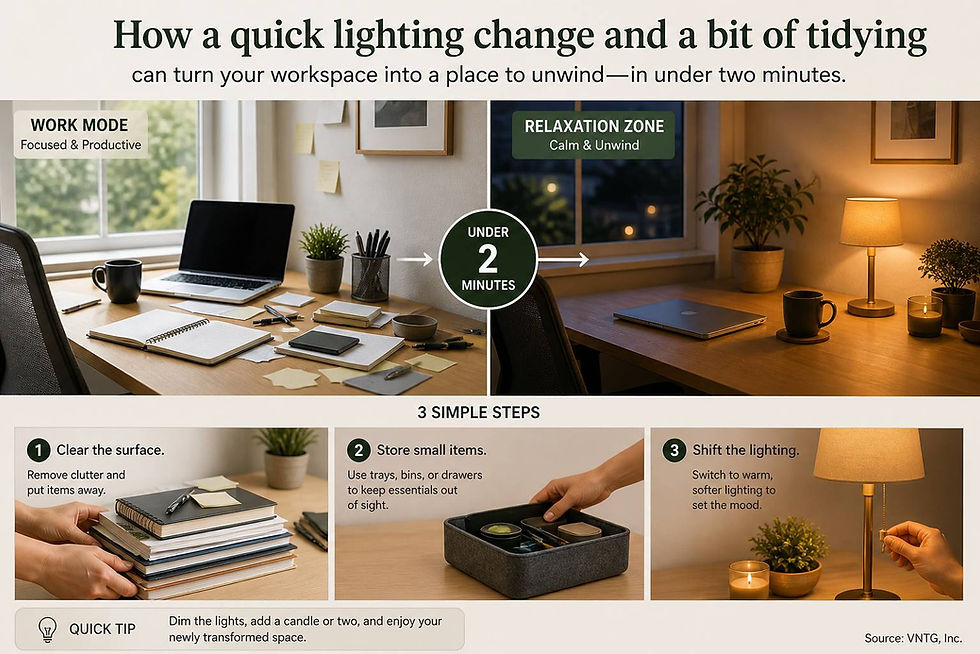
Lighting is the most powerful "invisible" way to hide your office without moving a single piece of furniture. By using a dedicated, sculptural Vintage Desk Lamp, you create a specific "zone" of focus. During work hours, this task lighting provides the brightness needed for productivity.
When that lamp is switched off and your warm, ambient floor lamps are turned on, the office area physically recedes into the shadows of the room. This signals to your brain that the workday is officially over. Look for task lighting with brass, chrome, or copper accents. These materials catch the evening island light and act as sculptural decor when the lamp isn't in use, ensuring your workspace doesn't look like a dark, "dead" corner of the room during your off-hours.
Frequently Asked Questions: The Hidden Office
How do I hide messy computer cords in a living room setup? The best way to manage "cable spaghetti" is to utilize a desk with built-in drawers or a Credenza with sliding doors. You can utilize existing cable paths (or have our team help you identify discreet routes) to run wires through the interior of the vintage piece, keeping the visual clutter completely out of sight from your guests.
Is a vintage chair actually comfortable enough for 8 hours of work? Absolutely. Many Mid-Century executive chairs were designed for high-ranking officials and professionals who spent their entire day at their desks. They prioritize ergonomics and comfort without the "gaming chair" or "corporate" aesthetic, making them the perfect hybrid for a luxury living room office. Explore our Chairs and Seating Collection for professional-grade vintage options.
What wood tone is best for an integrated living room office? We generally recommend matching the undertone of your existing "anchor" furniture. If your coffee table or dining set is Teak, look for a Teak desk. Maintaining a consistent wood species across the room helps the office "disappear" into the rest of the design, making the workspace feel like a natural extension of the room rather than an afterthought.
How can I define an "Office Zone" without using walls or dividers? A simple and effective trick is to use a small area rug to anchor only the desk and the chair. This creates a visual "island" that defines the workspace. Psychologically, when you step onto the rug, you are "at work," and when you step off, you have left the office.
Can VNTG help me find a desk that fits my specific room dimensions? Yes. You can filter our All Products page by size or visit our Kaka’ako showroom in person. We provide exact, detailed measurements for all our vintage pieces to ensure they fit perfectly in your specific nook, alcove, or behind your sectional sofa.
Create Your Sanctuary
Your home should be a place of rest, even if you work there. By choosing the right "Hidden Office" pieces, you can enjoy a productive day in the heart of Honolulu without ever sacrificing the beauty or the "soul" of your living space.
Visit the VNTG Showroom: 875 Waimanu Street, Honolulu, HI. Design for how you work, live, and rest.


Comments